Punishment from God – part 1

Question marks

People give me great theological questions quite regularly, I suppose because I am a pastor and they assume I have some kind of answer.  Which I do, quite often… but I’d prefer to call them responses rather than answers.  Answers put an issue to rest and finish the inquiry.  Most of the really good and deep questions don’t work that way.  And I don’t know “The Answer” in that sense.  Hopefully some of my knowledge, experience and reflection can point towards something illuminating, but as I like to say, it is probably towards ‘a better question,’ not ‘the answer.’

The question this time was ‘Who goes to hell, and what could be so horrible that God would do that to someone?’ 

First,  I’ve noticed that whenever I get into these big quandaries about God and faith that just don’t seem to be so un-understandable I usually find I’m asking the wrong question.  It’s no surprise that we get no answer or the wrong answer when we ask the wrong question.  The problem here is that we are so trained to ask this question.  “Who’s in and who’s out?”  Undoubtedly the Bible encourages this type of thinking in places.  Jesus’ story of the separation of the sheep and goats (Matthew 25.31ff) is an example of this.  But there are other messages.

One of those is the Gospel Message of unconditional love and acceptance, of a God giving his life in Jesus as a sacrifice paying for our sinfulness precisely so we wouldn’t have to.

Another is the redefinition of obedience that God points to already in the Old Testament (Hebrew scripture), Jeremiah 31.31-34 for instance, and that Jesus seals.  That is the notion that putting ourselves right (translate as ‘righteousness’) doesn’t come from following rules or doing the ritual right, but from an authentic relationship with God.  That is the theme of our worship service the week after Easter (March 30) when we kick off our UnLearn series with “UnLearn Religion.”

My studied and experienced sense of God is that while God is all about discerning what is better from what isn’t as good, it is for the purpose of calling out what if best, not to catch us at the worst.  What I mean is that God isn’t out to get us.  Find our flaws and trip us up.  It doesn’t take God to do that; we can do it for ourselves and each other easily enough.  We are imperfect, unworthy and undeserving at a pretty obvious level.  Stalin’s secret police leader is famous for saying, “Show me the man, and I will show you the crime.”  God, the creator of all things who declared them good is about finding, uncovering, redeeming and reclaiming that which is good and noble and usable within us and our world for the building of the kingdom.  God is about saving, not condemning. 

“Indeed, God did not send the Son into the world to condemn the world, but in order that the world might be saved through him.” (John 3.17)

The real question, the better question… I think it is something like this…

What is it worth to me to seek to know and follow God and live the way I am taught?

What is the cost to live trusting things that shall pass away, allowing the separation between God’s will and my reality to grow wider and wider?

The affirmation that I would add is this…

The more I learn and experience about God the more amazed I am.  And what amazes me is how good God is; graciously, unselfishly, extravagantly loving.  And if I could add to those superlatives, it would be that God does it with mind-boggling variety.  It is not one size fits all.  It is so creative that we often miss it.

So, who goes to hell and what could be so terrible as to deserve eternal punishment?  There are those who will give you the lists.  I’d rather not argue with them, but ask, “What will God’s love accomplish next, and how can I open myself to that love and show it to others?”  The former, to me, is a human question.  The latter, a Jesus question.  Let’s surround our lives with Jesus questions!

This is the kind of love we are talking about—not that we once upon a time loved God, but that he loved us and sent his Son as a sacrifice to clear away our sins and the damage they’ve done to our relationship with God.”  1 John 4.10 (The Message)


So, how DOESN’T God speak to us?

This post is a response to ‘Laurie’s’ comment to my “How Do You Find a Church?”

I think we hear God when we get quiet enough. When we journal. When we talk to people who have wisdom beyond our own. When we have long soulful conversations until 2 a.m. with a glass of wine (usually red). When we get close to ‘the fire.’ Times when we break our routine and open a window – preferably, but not necessarily, to the right direction. I know I often hear God when I exercise intensely. That’s why I like running by myself and never take music, those things take over the experience and I seldom hear from God.

BUT, more than any so-called Spiritual experiences I am convinced, like you, Laurie, that God just hangs out and waits for chances to tap our shoulders and get our attention. More often than not we don’t need deep spiritual wisdom from God, just a good reminder of what God taught us long ago. Typically the label on the back of my credit card that says, “Keep your lives free from the love of money, and be content with what you have.” (Hebrews 13.5) is all I need to hear from God when I want to buy something.

Is there any sense to the notion that it isn’t so much ‘how God speaks to us’ as ‘how DOESN’T God speak to us?’

After all, The heavens declare the glory of God, and the skies proclaim God’s handiwork. (Psalm 19.1) Sounds like it must be hard NOT to be hearing and seeing God’s presence all the time.

Me in You

Billy the Kid Documentary

We based our service today at Jacob’s Well on the Billy the Kid documentary filmed by Jennifer Venditti. See this film if you get a chance. It won Indie Film fests all around the world in 2007 and came to the Parkway Theater in Mpls this weekend along with creator Venditti who answered questions after the screening.

Dawn spoke about today and one of the points that she brought out – a Gospel message from the film and Venditti’s commentary – was that it is our job to see ourselves in the lives of others. That is a good point all in itself. It makes the world smaller and more humane when we see our lives reflected in others. But she went for a more profound statement, and that is that what really causes us to dislike, fear, even hate others is not the differences in each other, but the similarities. That is, what really threatens me in you, isn’t that you are different, but that i see myself in you. In fact I see things that I don’t like about myself or am afraid to admit to.

Could it be true? Do we laugh at the uncool kid, not because we despise him or her, but because we see a reflection of our own insecurity of being cool enough, of measuring up to the standards others impose on us?  Do we humiliate others for their imperfections because it is easier to do than to face ours?

I’m not sure there is nothing else at work in our differences and intolerances, but I think Billy and Jennifer are on to something.  The remedy, as Dawn presented it, is nothing other than having enough backbone in who we are (children of God) so that we don’t have to maintain our status by cutting others down.   Or as Isaiah (Is.43.1) and as Dawn also listed it, “Fear not, for I have called you by name, and you are mine.”

How do you find a church?

God told me…

We use billboards, bus benches, mailers, our website, guerilla marketing, pens, bottled water with our name on it, lots of invitations, anything we can think of to give people an excuse to try out God’s good news at Jacob’s Well… but who’d have thought of this?!?

This is a clip from a Communication Cards turned in on Sunday (2.3.2008). You know there’s a story behind this one. I can’t wait for all of Jacob’s Well to hear it.

Leap of Faith

Jacob’s Well started a second service on its 1st anniversary.  That was Sept.2007, and the service is at 6 on Sunday evening.  All our study pointed at this as the time to do it.  It’s great, but poorly attended.  We didn’t launch it right, we pushed it, but only in the context of what we are already did that has tons of momentum.  Now it is time to relaunch it.

Since we don’t have unused money, resources, time or people to do the launch, there was only one option.  Use who we have already to launch it.  This not only gives us a several hundred person launch team, it reminds us why we are here in the first place – to be about what God is up to. That keeps us on target and helps us keep out of reach of the grasp of institutionalism.

So we are suspending our popular 10:30 am service for the 4 weeks before Easter to be about one, and only one thing as a community for those weeks.  Getting a couple 100 new people to Jacob’s Well for whom the 6 pm service will be normative.

I don’t know of any church who has ever done this, but I think it is a noble experiment that has to at least teach us to never do it again.  We will accompany the switch with a heavy dose of advertising in the area and a major push on getting out into the community to meet people, as well as encouraging everyone to invite others during this month.

That’s the short intro to it all.  See the COUNTDOWN on our website (upper right).  It is ticking down the moments  until we start the second venue on Feb. 24 at 6 p.m.

Reading the Bible today

michelangelo-god-touches-usweb.jpg

I’ve had some great conversations with some folks lately. I am continually impressed with the questions and depth of personal investment people have in what they are struggling with. Most who meet me to talk over a cup of coffee or an email are thinking about faith, and one of the regular themes is the Bible. How do we understand, use, believe that book?

Clearly the way the Bible has been treated as an “inerrant and infallible” writing come from God isn’t working anymore. Is the Bible less than it once was? Or is it less to us than it is among some churches who cling to those claims? Wrong question!

Truth has a different role today. In a world that is as pluralistic as ours and where assumptions are not just challenged everyday, but dumped on their head, authority and absolutes just aren’t what they once were. Frankly, I think the Bible is becoming more alive and, theologically speaking, is becoming more powerful as it steps down from its ivory tower and starts living with us. Are there rumblings of Jesus in that statement?!?! Hope so…

Jacob’s Well was founded on the conviction that the Bible is not only relevant, but it is foundational. THE writing among many writings that have true spiritual strength. But it isn’t an instruction book. It’s truth is mined, not just spread like frosting. It’s truth is contingent on our willingness and ability to subject ourselves to it, and to bring our lives into the story. Indeed, without application to our lives there is no truth there at all. Just writing. Or as I like to say, the ‘book’ itself, white pages with black (or red, ugh… I am not a fan of red-letter Bibles… another blog…) is the dead word of God. The living word of God is embracing the people behind and before the story; the telling of the story around the fire at night 1000’s of years ago, the gradual recording of it, the editing, the compiling, the translation, the reading, the interpreting, the sharing of it. This on-going process is where inspiration happens, every step of the way. God’s word is alive when, and only when, humanity and humans engage and wrestle with the writing this way.

That means the Bible is contextual.  This is not its weakness but it’s strength and we live in a world today that is willing and able to see that!  I contend that it is comprised of universal truths (as far as human words speaking from particular contexts can express them) and the application of those truths. Our task, to read and apply the truths, and to learn from the application of truths (not to mimic them). That puts us in the messy situation of deciding which is which, but what about living by faith isn’t messy?

I read Scot McKnight’s blog, Jesus Creed (www.jesuscreed.org), when I have time (he writes a lot!). A week or so ago he blogged the notes below that are very interesting. They talk(in ‘theologian-speak’) about what Jacob’s Well is built on. These are six points that he believes characterize the emerging church’ s relationship with the Bible and “the Story” of what the Bible is pointing to. He seems to think they are healthy trends. I’d add that they are both healthy and inevitable. Deal with them! Interestingly they come from both sides, i.e. they show how post-modern culture is putting ‘religion’ in its place to make room for the Real World, and also putting ‘modernism’ in its place to make room for the Story. Here they are:

1. De-throning science as the sole Story.
2. En-throning a subjectivity as part of the real Story.
3. Embracing a local story as part of the real Story.
4. Epistemic (that means ‘intellectual’) humility about what one concludes from the Bible.
5. Acceptance of myth and fiction as capable of truth-telling. (I really love this one! Watch for a worship series on this before too long!)
6. Admission of cultural influence on all texts, even the Bible.

Any comments from wrestlers? Or from people who think we’re not supposed to be wrestling? I’d love to hear from either… just gives me another thing to wrestle with.

Sabbath was Good

Burntside - north armj

“Be still and know that I am God.” (Psalm 46.10) is often cited and for a good reason.  We need to let quiet and breaks from our routine bring space in our lives to be refreshed and to hear God speak again.  We had a great time up in Boundary Waters country.  Company, food, conversation, food, cards, food, skiing, did I mention food? was wonderful.  It was really cold, (high was -3, and typical temps were -25 to -15) but it was beautiful!  And there is something about being in the boreal forest of the north that makes the temps not nearly so cold.  I’d take -20 up there over 0 in the city anytime.  But then being the gimp I spent all my time by the woodstove anyway…

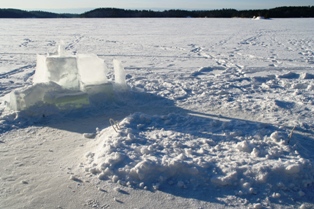
The picture is looking out from the sauna over the North Arm of Burntside Lake.  The little ice wall is built from the ice cut from the hole made for people to dip into the lake from the sauna.  At night (when we perform this crazed ritual) a kerosene lantern sits there, competing with the moon for providing illumination.  The rectangular spot of snow in the right foreground is the “door” covering the hole, snow piled on top, to keep the ice from forming too thickly during the day.  Remember, it’s 20 below zero.

If you look in the distance there is a little island 300 yards or so away.  it is a white lump against the trees on the horizon towards the right.  The teens got daring this year and multiple dips and snow angels in the snow to beat the sauna heat wasn’t enough, so they dashed all the way to the island and back wearing only their, well, you know…

Find a sabbath everyday.  Don’t wait for the big trips.  Let quiet break in for a short time everyday, and for a minute or two every hour.

Rest

Quick note to say I’m off to the Upper Arm of Burntside Lake, northwest of Ely, MN.  Our family is joining a couple of other families we have done this with for many years.  We get a rustic barn of a cabin where we share great food, drink, recreation and conversation.  It is adjacent to the BWCA so the ski trails meander through that wilderness.  For me it is a much needed break from always being “on” with my job and calling.  A time to allow my mind and heart to do some rumination and hopefully find some illumination.

The news on my ankle isn’t good (I now have an appointment with a surgeon…)  so I’ll be keeping the fire company while everyone else X-C skis in the sub-zero temp.  But the sauna and polar bear dip should still be within my grasp.

May each of us deliberately find a time each day, and a day each week, and retreat each year, when we are still and let God be God.

Peace!

Guiding Authentic Spiritual Growth

I looked at the last post [“Which is the greater danger?  Heresy or Blind Compliance”] and I had to say, “Let people make mistakes.”  I completely agree with the concept of letting people take ownership of their faith even though they will and do make mistakes.  And that ownership only happens when people learn for themselves.  But that word “for” is a big one.  It is “for themselves” not “by themselves.”

That means I don’t think it is helpful or responsible to let people wallow around in sloppy thinking or fall prey to deceptive thinking.  It happens too easily.

I’m going to start sketching out a formula for what I try to do, and I hope others will add comments and ideas and raise up examples that others have come up with.

One – Pray – The is a holy process that God’s Spirit is involved with.  It starts here, grows here and ends here.

Two – Scripture – Model a balanced approach to reading the Bible (primarily) and other writings.

Three – Vision – Supply vision for the purpose of faith and what it means to be a Christ follower in your context.

Four – Groups – Create and support opportunities for individualized learning and conversation.  Give general guidance to these experiences, but don’t manage them.

Five – Service – Encourage and give opportunities to people to practice what they believe.

Six – Listen – Leaders learn from what the larger body is discerning.  This allows the body to mature spiritually.

Start process over…

This was just a quick shot at the process… It is an inexact process and certainly full of holes.  Help me with them.  But then… maybe the holes are the faith part…

Which is the greater danger?

Heresy or Blind Compliance

Which way

Last Sunday, in talking about what it means to know Jesus, I talked about the ways it happens. There are a few obvious choices; like worship, the Bible, prayer, community.  But I offered a small stretch in ‘nature,’ saying that God wove patterns into creation that remind us of God’s truths for us.  Often these expressions capture God’s truth better than our words.  Then I took it a step further and offered that we get to know Jesus through ‘other writings and teachings.’  I said that something doesn’t have to be stamped ‘Christian’ to teach what God wants us to know.  Indeed, it could be far from God’s truth and still bear have the label.

I expected some phone calls and emails for that and was pleasantly surprised that all I got was a few thanks for saying it.  It is very consistent with our Jacob’s Well core values, so I shouldn’t be surprised, but it may just mean no one was listening…

God’s truth is what lies behind and in all that exists.  As such it is so big we can’t hide it forever.  It oozes out of every pore in our world, often especially where we least expect it.  That doesn’t mean that all things are good or helpful.  Much is not.  What is so important is that we don’t need to be afraid.  We can look and learn anywhere and everywhere.  Let Christ be the filter.  Trust the Spirit to guide us, and to rescue us from our errors.  Keeping ‘in the box’ of Christian teaching has certainly never prevented heresy in the past.

The point isn’t that Buddhism, Islam, Hinduism, humanism, etc. is right or wrong, but rather that God is so big that God’s truth can’t be hidden forever.  Different cultures, perspectives, languages, eras will inevitably express and hide God’s truth in ways that are novel to us.  Don’t be afraid, that’s the key.  Be humble, admit mistakes, don’t try to justify what isn’t working and keep the heart of the Bible at the heart of your searching.