Category Archives: emerging church

Who wants to be a member?

You will be assimilated

That’s the Borg Cube from Star Trek. Remember them? They are the ones who cruise the galaxy and ‘assimilate’ everyone so they are no longer who they were, but who the Borg are. No one wants to be one, except those already in. When we talk about becoming ‘a member of the church’ people look at us like we are the Borg invading their otherwise happy universe. In fact, even of our ‘regulars’ at Jacob’s Well (who invest generous amounts of time, passion, expertise and money in the community) react like, “You’re kidding, aren’t you? We aren’t going to do that ‘membership thing’ are we?”

Yet as David Stark taught me some years ago, the problem isn’t that people won’t commit anymore, people commit to all sorts of things all the time. Got a cell phone contract? I rest my case. The question people ask is “Is it worth my investment of time, money, energy, etc to make the commitment?’ Likewise, when I talk about what happens when we do commit to something and understand the truth of our relationship to the growing, developing organism that we call Jacob’s Well they think it is great. When I ask them to think of being a member not as having their names in the book, but like my arm is a member of my body – the arm is lifeless and both are incomplete without each other – then they get it.

Clearly committing to a movement and a community they believe in isn’t the problem. The language is. “Member” triggers an allergic reaction that says, “Oh oh, they are just like all those other churches. They really are just an institution and want us to keep them alive.”

I believe committing to a local church in a very concrete covenanting way isn’t only a good thing, I think it is an essential part of committing to a life of following Christ. The local church is the manifestation of Christ’s body in a specific location. It is the means through which God can touch the lives of people in all fullness. We are looking at ways to talk about and do it.

Before I say what we are thinking of doing I would like to hear your thoughts, reactions and experiences.


UnFocused, UnConnected & UnCommitted

Following on the discussion of people liking Jesus and not liking the church, my experience  is also that people consider themselves ‘spiritual,’  but not ‘religious.’   Spiritual is a good thing, religious is not.  I know what they mean and feel.  Spirituality is the raw experience, the relationship with that which we call God.  Religion is how we practice it.  Spirituality is the real thing, religion is the human-made construct we use to follow it.  Religion should always be subservient to the spirituality it is trying to nurture.  This relationship has a tendency to turn itself upsidedown, however.

The problem is that without ‘religion’ (i.e. some form of organized pattern of nurturing and sharing that which is spiritual) ‘spirituality’ suffers.  In fact what I find is that most people who consider themselves to be spiritual, but not religious have an UnFocused, UnConnected and UnCommitted spirituality.  And consequentially an immature spirituality.  Those 3 words are very important.

This provides a church with a lens through which to examine what it offers and what it seeks to accomplish.

  • Can we help people focus what they call spiritual?  While we have to make sure our God is big enough, we don’t benefit from approaching God like a buffet line.  “I’ll take a little of this and a little of that in my god.”
  • Likewise can we connect people together on their spiritual journeys?  We can’t do it alone.  We weren’t meant to.  We need to learn from and teach each other.  We need encouragement and accountability.
  • Can we offer meaningful, relevant commitment.  Not like becoming due paying members of a club, but we grow when we “run the race with perseverance that was set before us.” (Hebrews 12.1)  Contrary to what many people are saying, younger generations arenot unwilling to make commitments.  (I know a 26 year old who just took on a 40 year mortgage!)  They just want to make sure what they are committing to is worth their investment.  Commitment to spiritual growth makes it happen.

We are all spiritual beings, and finding focus, connection and experiencing the benefit of commitment to what we value above all other things is like a cool drink to a parched and thirsty life.

Jesus “Yes” – Church “No”

jesus-not-church-book.jpg

Anyone read Dan Kimball‘s recent book, They like Jesus, but Not the Church? I’m looking for recommendations and discussion. Here’s a link to a review by Christianity Today via Outreach.com

Looks good to me and certainly ties into a lot of how I see the “given up” viewing our faith. Jesus is good, he is a person, like them. The institution of the church, however, is seen much differently. Suspicion of institutions in general, and distrust of the organized church in particular abound in our culture and are spreading.

One of the interesting things I have noted is that when most institutions fail their “leader” either goes down with them, or that person’s personal failure is the cause of the institution’s demise. Not so with Christendom. While the institution of the church is on the rocks (and Christendom is dead, except in a few museums of our faith) the leader, Jesus, remains in high regard. My “given up” neighbors are most often not ready to say Jesus is the Son of God, but they give him a status above other leaders. They want to know more. And almost across the board they say, “If the church were more like Jesus, I’d be interested.” Which reminds me of Gandhi’s quote, “I love your Christ, it is your Christians that I have trouble with.” (not an exact quote…)

Which is why at Jacob’s Well we don’t talk about being Christian, but being a Christ follower. We don’t call ourselves “Jacob’s Well Church.” But in connecting ourselves to the church idea we do it by saying things like, “The kind of church you’re thirsty for” or “a church for people who don’t like church.” People get it.

Anyone read Kimball’s book? Recommendations or discussion?

Being Christian is not a good thing anymore! KNOW THIS STUDY

Kinnamon’s ‘UnChristian’The Barna Group has just published a study that we all need to pay attention to.  I first heard about this research from Brian McLaren a year and a half ago and it helped me focus the shaping of Jacob’s Well.  This study of 16-29 year olds shows how this generation, more than any preceeding generation is not only uninvolved and uninterested in Christianity, but actually views Christianity and the church as a negative.  The subtleties are important, but the overall trend cannot be ignored.

A good question (and I’d like to see some conversation around this) is whether it is even worth trying to convince the “given up” (a Jacob’s Well term) generations that our language, structures and traditions need to be picked up, or is it time to invent new modes of being church and move on?  It is a little hard to ignore the comparison to the controversy among the Apostles (Acts 15) over whether Gentiles should have to be circumcised or not… whether nonChristians should have to learn to like organ music (an ironic comparison, sorry), whether new believers with new questions of God should have to confess faith in ancient creeds that were answers to ancient questions…

You can read a great summary of this in the Sept 24 The Barna ReportIf you are a church learner, subscribe to this!

Kinnaman’s book UnChristian is the full report of the study.  I’ll blog a review when I finish it.

Practicable Christianity

I’ve got to write this one down. I had a conversation with someone who is loving Jacob’s Well and, judging from her experience with church and religion in the past ,this is surprising. I asked her what she liked so much and among other things she said, “It’s like practical Christianity.”

That stopped me for a moment. My old instincts took over and made me think that ‘practical’ was mundane, maybe even “works righteousness” oriented. Then my mind started flooding with Bible verses,

“…teaching them to obey all that I have commanded you…”

“…faith without works is dead…”

“…take up your cross and follow me…”

“…hear the word, accept it and bear fruit. Thirty, sixty and a hundredfold…”

We started Jacob’s Well to help people have a relationship with God that made a difference in their lives, that gave them traction. We believe God isn’t just a good idea and faith isn’t just a set of doctrines but a mode of life – relevant and valuable to us everyday.

I have been criticized for keeping praxis lock stepped with doctrine, but that’s part of being precarious. C’est le vie. If the alternative to ‘practical Christianity’ is ‘impractical Christianity’ count me in on practical!

g-on-boardbacksmall.JPG

Vision setting

Jacob’s Well in the next 5 years…

…you asked, so here it is.  Let me say that this is at 35,000′ so it has little substance, just BHAGs.  Let me also say that it may sound smug and prideful to you, and it may be, but I want to believe that the only thing keeping God from using Jacob’s Well for great things is our lack of imagination and courage.

There are two sides to the Vision…

First, Jacob’s Well is our attempt to start a new congregation in an established community for the huge population that has given up on church. It is our intent to grow in depth and breadth. Rapidly!  Why not? (What if a church could do that in an urban setting?!?!)

Second, we are trying to develop new models for ministry that can be effective among the population that doesn’t like going to church. Models that are built on principles (biblically, theologically, sociologically sound) not on styles or personality, so that the models can be contextually applied in other locations.  (What if Jesus’ Church could grow with Acts-like speed in the U.S. today?!?!)

In brief:
Jacob’s Well

2006 Secure funding.  Gather launch team.  Rattle the neighborhood and launch a church for people who don’t like church.  Have new people from the community outnumber the launch team quickly.

2007 Launch second service, implement youth ministries, groups, discipleship process, ministry base of congregation, stewardship.

2008 Second venue for Sunday a.m. worship with its own campus pastor, but rotating speaker and band. Service will be the same as at the Field location. Continue to implement groups, strategic ministries. Develop service and mission through strategic alliances.  Achieve financial self-support.

2009 Launch 3rd (& 4th) venue. Same pattern as 2nd location. (What is really keeping us from launching at least 1 new community every year except our own inability to believe what God is up to around us?) Group life is the solid building block of the community. Special worship experience for youth. Major investment in the neighborhood by congregation.

2011 Association of congregations in the urban metro area (and beyond?), each self-supporting, but with shared office, sharing resources and using it to develop relevant, valuable, creative worship experiences that bring people into the presence of God and create participants into community.

Model of Ministry

2006 Apply to Jacob’s Well.

2007 Unlearn, unlearn, unlearn.  Learn, learn, learn.  Develop and experiment.  Learn from failure.

2008 More of the same.   Begin coaching group for church launchers in the upper midwest.

2009 Help launch congregations in other cities.  Offer first conference.

2011 Association has major role in developing other congregations in other cities as well as developing local venues.

Church Launcher Resources

I’ll start a section on our http://www.jacobs-well.net website with resources that other church developers may want to take a look at. But for now they are there with no navigation route to them, you just have to type in the address accurately.

Discontinuity Teasers (to help get your leadership thinking in terms that allow God to always shake things open. www.jacobs-well.net/discontinuityteasers

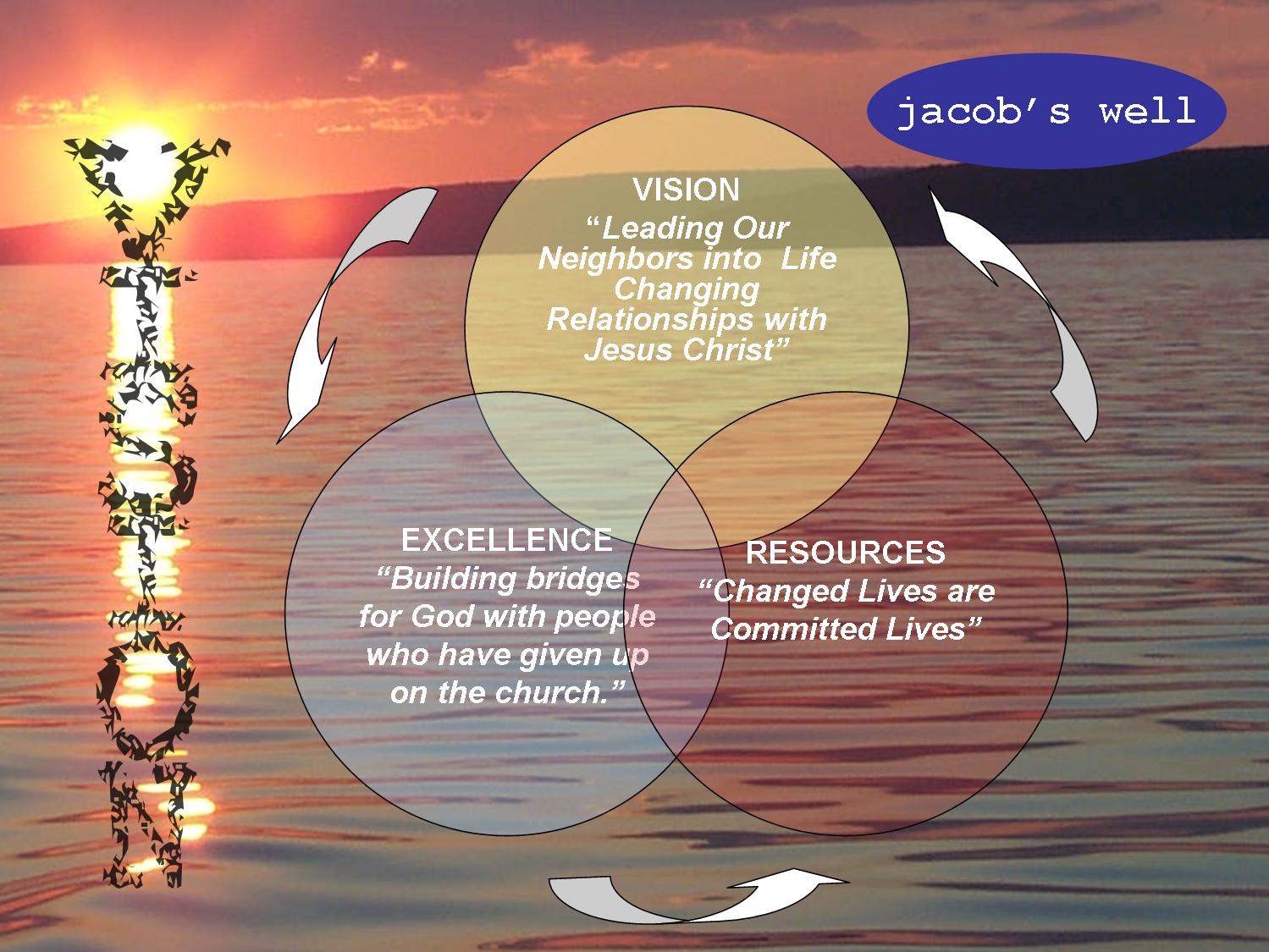
A copy of our Vision in a diagram. www.jacobs-well.net/visiondiagram

A description of the bullseye in our target, Jack & Jill. By knowing and understanding them well we can better and more meaningfully serve them. http://www.jacobs-well.net/jackandjill

jack-jill.jpg

jacobs-well-vision-diagram.jpg

Discontinuity Culture

It occurs to me that one of the things we are trying to do at Jacob’s Well is something I’ve tried to bring into the established churches for the last dozen years. The “what if” concept has helped me see how the emerging church needs a ‘culture of discontinuity.’

discontinuous pencilA “what if…” church, filled with “what if…” Christ-followers has a culture of discontinuity rather than of continuity. They are rooted in where they have been, but they don’t take their foundation as an anchor. Rather it is a springboard to what God has next for them. They live out possibilities in the name of Christ. That means status quo, equilibrium, ‘the way we’ve always done it’ aren’t goals. Change is sought, not fought.

I developed a series of “Discontinuity Teasers” years ago that I’ve used with our staff at Bethlehem and many other staffs and groups of church leaders to help them see the possibilities of a culture of discontinuity, and how to develop that sort of thinking in their organization. I’ll post it in the “church transitions/resources” portion of our website (link below). Check it out and let me know if it is helpful, or how you would improve it. It is quite a few years old and wasn’t designed for an emerging church, but for an established church.

www.jacobs-well.net/discontinuityteasers

The priority of traditions

I’ve had a number of conversations with very passionate, concerned and intelligent people in the church recently about the role of tradition in congregations. Not the tired debate of guitars or organs (not that it is resolved), but of connecting to the historic rather than the contemporary, and the larger denominational identity rather than an isolated congregation. There aren’t clear cut answers. Books are written on the subtleties of the conversation, and our email and coffee shop chats have come close. What I really value is that all the people I’ve been talking with aren’t out witch hunting, but are seeking something that answers their needs as lifetime church-goers and/or professional clerical types, and the needs they realize are beyond the doors of their church buildings.

My sense isn’t that traditions or denominational identity are good or bad, beneficial or baggage, but it is a matter of how they are used and when these ‘cards’ are played. Two things are at work here.

One is that both the traditions of the church and the denominational institutions that have carried the truth have been allowed to wander off onto thin ice. Both are perceived (rightly or wrongly) as, at least, somewhat irrelevant and with some suspicion by a majority of Americans. Bridges of interest and trust need to be built before the people we want to re-engage with the church will give the church a chance.

The other is in a cultural change in how people experience authenticity. We are so barraged by messages and claims we have been trained not to believe everything we see and hear. Younger generations have experienced failed leadership at so many levels (political, church, corporate, parental) that they care little about what people say, they want to know what we do. The cliche is “the walk, not the talk.” or praxis vs dogma. Regardless, the outcome is that authenticity is established differently than it was for previous generations. Our institutional connections don’t reassure our disenfranchised public that we are authentic. Reading a prayer or a participating in a written liturgy that is printed in a book or a program don’t either, in fact it is more likely to be perceived as inauthentic because it comes from a book, not the heart. Rather than such works ringing bells of deep, historic connections, they ring warning bells of hypocrisy.

My point: Our traditions and institutional identities are good and valuable, but they are not the message, and in fact get in the way of the message for many people today. To put them on the back burner in order to establish relevant and authentic connections with people who have given up on the church is not selling out, or dumbing down, it is putting putting first things first. I ask myself, “am I trying to make Lutherans or followers of Jesus?” And the answer is always that they are both good things, but there is no doubt as to which comes first.