Category Archives: ethics

Hey U.S., Who Are Our Neighbors?

The party in political power at the moment has asserted a reinterpretation of Jesus’ and the Bible’s teachings about our neighbor. Who the neighbor is, and what our responsibility to them is in relation to our responsibility to ourselves and our closest circles of family and community. We see it being played out in executive action and legislative inaction. On January 29, 2025, Vice President JD Vance in a Fox News interview said, “There is a Christian concept that you love your family and then you love your neighbor, and then you love your community, and then you love your fellow citizens, and then after that, prioritize the rest of the world. A lot of the far left has completely inverted that.”

No, there isn’t s biblically based Christian concept like that, Mr. Vance. There are many issues that can be seen differently but this is not one of them. Neither Jesus nor the Bible in general have any ambiguity on this issue. In fact, biblically speaking, asking whether there is an order to our responsibility is the wrong question to ask. The question isn’t “who first?” but “who needs us?” We are directed to love others, and yes that can be hard and require sacrifice on our part, but it is intrinsic to the life and faith of Jesus and the message of the Bible. Let me walk us through a few places in the Bible where this is made clear.

Jesus’ parable known as The Good Samaritan told in Luke’s Gospel (Luke 9.25-37) speaks directly to this. It starts with an expert on the law, someone who teaches and explains the Torah in the synagogue, coming to Jesus to test him. He asks what he must do to inherit eternal life. The word ‘test’ suggests that he was there to try to trip up Jesus. And Jesus characteristically turns the question back to the man. “What does the law say? How do you read it?” To which the man answers “You shall love the Lord your God with all your heart and with all your soul and with all your strength and with all your mind.” This comes right from the Torah he is the expert on. That love mentioned doesn’t mean to just adore God, but to align with God’s ways, be in right relationship with God, or to use biblical language, be righteous in God’s eyes. Then he adds another bit of the Torah as if it were part of the former, “and [love] your neighbor as yourself.” Loving oneself is affirmed but not as an end to itself, it is a model for loving the neighbor.

Jesus tells him he got it right, “You have given the right answer; do this, and you will live.”

That leaves some wiggle room though. After all, those strangers far away, or new to my community aren’t really neighbors, right?! And that is exactly the question the man returns to Jesus, “Who is my neighbor?” The story tells us he asks this to justify or vindicate himself. Perhaps that means to get himself off the hook for the implications of what he just said the Torah, the Bible, says. Regardless of his motives Jesus’ answer has the same message, and he answers with a story, a parable.

The story is likely familiar. A man was on the road out of Jerusalem and was mugged. Stripped, robbed, beaten and left in the ditch. Two people pass by – both Jews. A priest and a Levite. People of authority in the religious and civic life of the time. They pass by ignoring the man. Then the parable tells us a third came by, a Samaritan. Samaritans aren’t Jews and, to use modern terms, are highly polarized from the Jews. Of the three, this is the one we would least expect to help, but he does. The Samaritan tends to him, inconveniences himself, pays for his care and follows up with him.

At the end of the parable Jesus asks, “Which of the three was a neighbor to the man who was robbed?” The man of the law not quite able to say the name “Samaritan” says, “The one who showed him mercy.” To which Jesus says simply, “Go and do likewise.” [It is worth noting that Jesus doesn’t say, “Wait and do likewise, if someone with need shows up.” Jesus says “Go!” He calls us to action. He sends us out to seek and serve the brother or sister in need.]

Jesus defines neighbor as the person, known or unknown by us, near or far. Simply put, everyone. And he defines the nature of our relationship with our neighbor: Care for them. Not if it is convenient, not if we have everything of our own fully taken care of. No, “Love your neighbor just like you would love yourself.” A command that is repeated in Matthew and Mark’s gospels, and in Romans, Galatians, and James. Love the outsider, love the needy, whoever they are, just like you would love yourself. That is a reflection of loving God with your heart, soul, strength, and mind.

This teaching of Jesus isn’t meant to take away from self-care, nor be an excuse for neglecting our own family or community. Rather it is there to remind us of the larger family we are inextricably part of. God’s family.  

Let’s look at another familiar story from Jesus. As he is teaching he talks figuratively about The King, God, who speaks to those who have either done or not done what he willed them to do (Matthew 25.31-46). They were asked to ‘feed the hungry, give a drink to the thirsty, welcome the stranger, clothe the naked, care for the sick, visit the imprisoned.’ He ends by telling his listeners and us, “Just as you did it to one of the least of these brothers (and sisters) of mine, you did it to me.” The ‘least’ of my people; the most trivial, insignificant of them. No conditions. In prison rightly or wrongly. Familiar or stranger. Deserving or undeserving. They all count, they are all neighbors, God’s people, our family. There is no order among them giving preference to those nearest you genetically or geographically. After all, according to Jesus’ story it is The King, God, whom we are loving when we do this.

We can reach into the Old Testament and find this theme played out repeatedly as well. God doesn’t prioritize the powerful or the familiar over others. More often the Bible gives a seat at the table to one whom others wouldn’t expect, understand, or like; Joseph, Moses, David to name a notable few. After all, Israel itself was made up of the least among the people of their day, and Good loves, provides, and executes justice for the outsider as this passage from Deuteronomy (10.17-19) records.

For the LORD your God is God of gods and Lord of lords, the great God, mighty and awesome, who is not partial and takes no bribe, who executes justice for the orphan and the widow, and who loves the strangers, providing them food and clothing. You shall also love the stranger, for you were strangers in the land of Egypt.

We can cite example after example of this basic recognition and value of the stranger, like in Paul’s letter 1 Corinthians 10.24  “Do not seek your own advantage, but that of the other, the neighbor” but the best witness is God and Jesus themselves. “For God so loved the world (read everyone and everything), that God gave his only son…” (John 3.16) No prioritization or protection for those close to oneself in God’s love there! God so loved seemingly others that he gave up what was closest. Wow! And then there is Jesus. He was a model of self-sacrifice for humanity. He gave a gift to all people – that includes you, it includes me – of what was closest and most precious, his life.

As individuals, and as a nation, do we care for our own first, and then those close to us, and if there is enough, then others too? Is it the responsibility of those closer to them to care for them, not ours?

Or do we seek to help the marginalized, the poor, the disadvantaged? Do we welcome the stranger? The latter is what Jesus did, and his word to us, “Go and do likewise.”

Moral High Ground: Doing the right thing because it is the right thing after bin Laden’s death

Only one thing struck me more powerfully on September 9, 2001 than my numbness and sadness over the event, and that was the wave of sympathy and support the world had for the United States. Sure, we were still the global bad boys (you can’t be the biggest kid on the block and avoid constant criticism), but others with nothing but hatred had struck a low blow and the world didn’t like it. A window had opened. We had the moral high ground and a chance to move forward; pursuing justice, certainly, but also pursuing all of what makes our nation great. The world was suddenly and strangely moldable. Had we as a nation confessionallyadmitted that we had done things to fuel anger and resentment in some people and nations, and proclaimedthat this was now over, we could have used our considerable influence, creativity, wealth and new found receptivity to help shape a new world known for justice and equality, peace and cooperation. We could have starved the flames of terrorism. Instead we fed and fanned them.

We have another window of possibility now. It is not nearly as wide as the one ten years ago, nor will it stay open long, but it is open. Our expenditure of enormous resources and attention on pursuing Osama bin Laden has removed him as the figurehead of terrorism. While everyone knows that terrorism is far from over because of this one man’s death, the question is, “What will theU.S.do now?” Was bin Laden just one big block to knock over and we will continue to knock over more blocks until none remain? Or will we start something new in the world?

We have removed the leader of this movement of destructiveness and now we can replace it with a leadership of hope. We can turn to the places in this world where people feel that they have no choice but to lash out at the world, and we can create opportunity. We can go to the places where justice has no voice so that lawlessness is a necessity, and we can bring accountability.

I am not a political scientist; I am a person of faith who trusts in the power of what God is doing in this world. I am sure that my proposal is naïve and unpersuasive to those who are looking at the facts of the matter, but dealing with the facts of the matter has made our world less safe and more factionalized. It is the job of every person, community and nation to do what is right. Not only because it is good for oneself, but because it is the right thing to do. This is what it means to live in hope.

And we will discover that doing what is right for the whole world (and this doesn’t just include political powers, or even people, but creation in its fullest and most inclusive sense) will be in our national interest, creating the best world for us to live in as well.

Ought I rejoice over Osama Bin Laden’s death?

The news stations are all reporting that Osama Bin Laden has been killed and Barack Obama is expected to speak momentarily about it. The news reporter from whom I first heard the story stated that he thought he’d never be able to report this, and was (I’m not quite sure of his exact words) was very happy to be able to do so now.

I feel a little premature in saying too much since we know so little about what happened, but all the circumstances and the reckoning of the justice of such an act aside, the basic fact remains: a human being has died.

The Haggadah of the Jewish Passover Seder comes to mind as I hear this news. One portion of the Haggadah reflects on the Egyptian army that was drowned in the Red Sea as they pursued the people of Israel after their escape from slavery in  Egypt.  Their defeat is a basic and essential part of the history of the people of Israel. One would be tempted to rejoice at this point of the narrative because of the Israelites’ victory, yet lest this happen, Rabbi Hillel added some commentary to the Haggadah that is often remembered. He wrote that upon the drowning of the Egyptians the company of heaven began to celebrate, but God commanded them to stop saying, “Would you rejoice? Can you not see that some of my creatures are perishing?”

I do not mean to compare Egyptians to Muslims or Bin Laden, nor to make the cause of the Americans ‘holy’ like that of the biblical story. Neither do I intend to underestimate the pain and suffering of those who died in 9/11 or in the ‘war on terrorism’ since, nor their families who lost loved ones. I do not mean to say that Bin Laden should not have been killed, it seems that he was one for whom Jesus’ words were true, “all who draw the sword will die by the sword.” [Matthew 26.52] Nonetheless, it seems that the God I have learned to know, and love, is saddened at the death of God’s child, Osama Bin Laden. Just as God was saddened at the death of the person who died on the 84th story of the World Trade Center, and the firefighter, and the man who commandeered one of the planes that crashed into it. And every other person who suffers on this planet.

Ought I to rejoice? I rejoice that the hand of terrorism may have been weakened. I do not rejoice that a person has died, even if it was just, deserved or necessary. And I am more than a little troubled about the soul of our nation who seeks to draw the sword to bring about the kingdom we seek for ourselves.

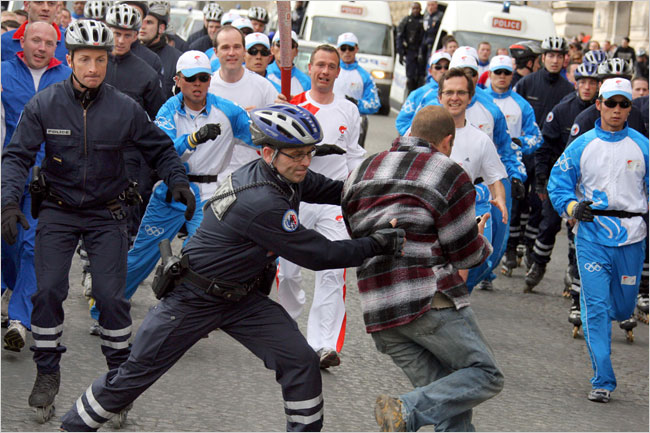
Olympic Protests or National Accountability?

Olympic Torch Protest in Paris

The protests over the Olympics have really gotten my attention.  My very first reaction was why would people mess with this wonderful tradition of the Olympics and the carrying of the torch.  I mean, what could be better than that?  But that isn’t the point, is it…  People aren’t protesting the Olympics, but they feel compelled to speak against the host country.  They are saying ‘something is rotten in Denmark’ (or China, in this case) and we can’t just say, “Rah Rah Olympics” when the host is oppressing a nation (Tibet, again, in this case).

Now I’ve no intention to comment on human rights abuses in the People’s Republic of China.  But I find the idea that the world (i.e. citizens of other countries a long, long way away from them, and with little or no say in that country) feel it is within their rights, responsibilities, even duty to hold China accountable.  I realize expatriated Tibetans, who are very involved with the situation are doing a lot of the protesting, but their support comes from their new countries of residence.

One of the unhelpful responses is for us westerners to point our fingers at China and say, “Ha, teaches you right.  You are doing bad things and the world is unhappy with you.”  We are tempted to do that because China has us all scared silly with their growing muscle in the economic, research, population, manufacturing, etc worlds.  You name it, after being in the lead so long we don’t know what to do with the fact that we see a much bigger vehicle approaching quickly in our rearview mirror.

The fact is that the world is shrinking.  While the world is getting more and more sophisticated and urban anonymity is more and more available to us, we are also getting closer and closer to each other.  We have a million ways, and a million watchdogs helping us look over each others’ shoulders.  And so our noses are in each others’ business.  Rightly or wrongly… doesn’t matter.  We are doing it.

Here is the other fact, lest we be smug Americans (this could also be written for Europeans, Australians, Japanese, whoever… but I’ll let them speak for themselves).  If the Olympics were to be held in the U.S. the torch bearing would be going no more smoothly.  Can you think of any nation whose citizens wouldn’t be stopping the torch and saying, “Out of Iraq!”  or “You’re not our policeman!” or “Clean up your industry before you tell others to do it!” or “Free the detainees in Guantanamo!” or “Restore Civil Rights in your country!”

Again, I’m not endorsing those critiques (although I do have my opinions; you have to buy me a beer, not just read my blog to get those), but I am saying that the same accountability the ‘world’ is leveling at China would also be leveled against us.  And we’d have to face it.  Here’s what we can have control over… actually two things:

1. Is it a good thing?  Is this just entitled judgmentalism on a global scale?  Or is it a global conscience learning how to flex its muscle? I’d venture a guess that it is a little bit of both and that such attempts are probably the only way the global community will learn to be mature with its new found power.  Besides, its going to happen, might as well get the adolescent acne stage going so it can be over with.

2. Are we going to seek to be ‘above scrutiny’ or not?  Is there, at least some, truth in the charges coming from all quarters that we can learn from? Again, I’ll venture a guess and say, “yes.”

Are there some early sounds of the kingdom of God in these groans of childbirth?  Hmmm…

The Irrestible Revolution

Shane Claiborne’s The Irresistible Revolution

I meant to include a reference to Shane Claiborne‘s book The Irresistible Revolution on the last post about the church getting involved in changing the world, not just changing themselves.  Following the path begun by people like Jim Wallis (who wrote the forward) he is setting out a great challenge for the church today.  I don’t think what Shane is doing can be normative, but it also cannot be ignored.  We read this as a staff last winter and it continues to mold our thinking and hopefully our development as a church.

The UpperRoom has had Shane visit and has used this book as group study material.  Sounds like a good idea to me.

Political as well as Personal Relevance

The paragraph below is part of reader Jenna’s very articulate comment on my post “Being Christian isn’t a good thing anymore.”

“...what about bigger problems like racism, poverty, and lack of access to education? Many churches focus on these issues at the global level, but problems like these are very present in Minneapolis…”

Boy, I know what she means. I’m going to try to respond and I’ll bet my response won’t be wholly satisfactory to anyone, including myself. So I’d love more people weighing in on this.

1. Yep, we do have to raise our voice as followers of God. The Bible consistently balances (if not trumps) the personal impact of faith with the societal impact of it. I do not think the societal (or political) is anymore important, but that God is highly suspicious of any manifestation of faith that doesn’t start reshaping the world around it.

2. Politics are dangerous in church. Here’s why. Not because we aren’t supposed to be political, but because politics tries to regroup us according to our stands on issues and stake its claim on us as its adherents. That isn’t the job of politics, that’s God’s job. Our only unwavering adherence should be to the gospel and its transforming power in us and through us. When church bodies (local, regional, national) have taken political stands on issues they have usually done it badly. They take votes that make losers and winners, dividing the unity of Christ. Losers either leave, alienated from the dialog that might have furthered understanding and growth; or they retreat until they can mount their forces to overthrow those who won last time.

3. One of the core values of Jacob’s Well is “We value unity and diversity. We focus on the mission that unites, rather than the details that divide.” How do we do that? It isn’t easy, but we already hold a large range of diversity in our community with almost no conflict. If we only do that by avoiding issues it is bankrupt, but I don’t believe that is the case. My vision is that the church is called to convict people with God’s desire for justice and compassion. The church has to be ‘prophetic’ about what the real issues are. The action, however, is a response of faith. It is individual and we are called to be tolerant of and engaged with each other despite our varied approaches. Face it, we never know for sure when we are right. It is the church’s place to say, “Racism is a problem. Here are some of the things the Bible says about it. Here are questions that we as people who carry Jesus’ cross with him are called to figure out and act on.” But it is not the church’s place to say, “This is the only right response to racism.” Or “This is the right stand on the issue of racism.”

4. I will freely admit that this is a growing area for me to learn how to walk the precarious edge of calling a community to action in the political/social sphere, but not endorse policies or candidates. We are trying to learn, however. We did a series (IMUR) some months ago working from Jesus’ “I am” statements in John’s gospel. Two weeks focused on local justice issues with expert guest speakers. One dealing with poverty and race issues in our neighborhood, and another with Muslim/Christian relationships. Two Muslim speakers helped me with deliver that message. This summer we did a series (Is God Green?) dealing with environmental issues and capped it off by having our worship one Sunday be actually working on projects that improved the environment. We gave everyone a dvd afterward with a message from me (and another for kids) to help interpret the experience. (If you want a copy of the dvd, let me know.)

5. We believe everyone should have a ministry within the church and a mission beyond it. That will be a goal for Jacob’s Well forever. That ‘mission beyond’ will be different for every person, but we will try to help everyone see that their voting, their voices to elected and appointed government officials, their volunteering, their influence over friends and neighbors, and their mere presence in the community should be understood as part of their mission.

Sorry for so long a response, but Jenna hit a hot button for me that I wrestle with a lot.

Held accountable

I finished my message yesterday at Jacob’s Well with Tony Campolo’s story about throwing a birthday party for a prostitute in the middle of the night.

(Great story, if you don’t know it see his book, The Kingdom of God is a Party. You can also find it on the web on sites like this.  But buy his book anyway.)

It’s a powerful story that calls us out of our “nice and tidy” ministries and out into the “down and dirty” love that Jesus was about.  My concluding words were, “What if there was a church that threw birthday parties for prostitutes in the middle of the night?  I want to be the pastor of a church like that, and I hope that you want to help Jacob’s Well be that kind of church too.”

no-shoulder-sign.jpg

Afterwards a woman came up and said, “Great message, I love that vision of the church. But I wonder if you really mean it.”  She went on to a say a few other positive but challenging things and then ended by saying, “I’ll be watching you.”  I told her I needed accountability, we all do.  She had been burn by a church that didn’t practice what it taught, and is sharp enough to know that while I’m not Jacob’s Well, if I don’t believe and practice something it is pretty unlikely the church will either.

My first reaction – Wow!  Someone was listening and taking me seriously enough to call me on what I say.  That’s what preaching is all about.

Another reaction – Being a precarious pastor and a congregation that ministers from the margins rather than soft, safe center of its resources and comfort level isn’t easy.  We have to hold each other accountable so we will go where Jesus goes.  We also have to encourage each other and remind each other of the vision with which God leads us out of the wilderness of our comfort zone.

Anyone else ready for this journey?  What will we have to give up to be that kind of church, and are we willing to do it?

Why do we do what we do?

my mom

This is my mom.  She’s 87.  She’s great.  She’s the one who did all those mom things for me that you don’t really appreciate growing up because you don’t realize someone is doing them for you.  After all you never experienced life without someone doing them for you.

Now Mom is on her own.  My dad died in June; he was 91 and they had been married 66 years and 7 days when he died.  My mom also has a very poor memory.  She doesn’t have Alzheimers and she can function just fine at the fantastic assisted living facility she is in.  But she just can’t remember the simple things she just did.  Like what she just had for lunch, or what she did yesterday.  She can’t really read a book anymore because she has not only forgotten about the last chapter, she has forgotten she had started the book.

When I visit her we have a great time.  She knows who I am.  She remembers my kids and where I live and that I’m starting this new church.  She can do crossword puzzles faster than I can read the clues and she beats me in at least every other game of Scrabble.

What she can’t do is remember that I visited.  When I go home and call to let her know I made it back safely and she knows how to play along, but I suspect she has already forgotten I was ever there.  If I call the next morning she is likely to end the conversation with, “I hope you can come and see me sometime.”

So why visit? I get no credit for it.  It has no lasting impact.

So what.  She’s my mom.  I want to see her.  We have a great time.  She may ask all the same questions every visit, several times every visit, but she cares about and understands everything I tell her.  She gets another chance to love me, and I remember how much I love her.  And maybe the brightness of that day makes the next one a little brighter for her, even though she doesn’t know why.  But I know.  It is the right thing to do.

Life is about doing the right thing, because it is the right thing to do, not because of hope of reward or fear of punishment.